

SGOT & SGPT Explained: What High Liver Enzymes Really Mean
Your health-check report arrives, and most of it looks fine. Then your eye catches two lines flagged in red: SGOT and SGPT, both higher than the range printed beside them. Suddenly the whole page feels ominous. Is your liver failing? Did you do something wrong? Should you panic?
Take a breath. Raised liver enzymes are one of the most common findings on a routine blood test, and in the large majority of cases the cause is manageable and often reversible. But the numbers do mean something, and understanding them helps you respond wisely instead of fearfully. This guide explains what an SGOT SGPT test actually measures, what high results point to, and the practical steps that bring the numbers back down.
What Are SGOT and SGPT?
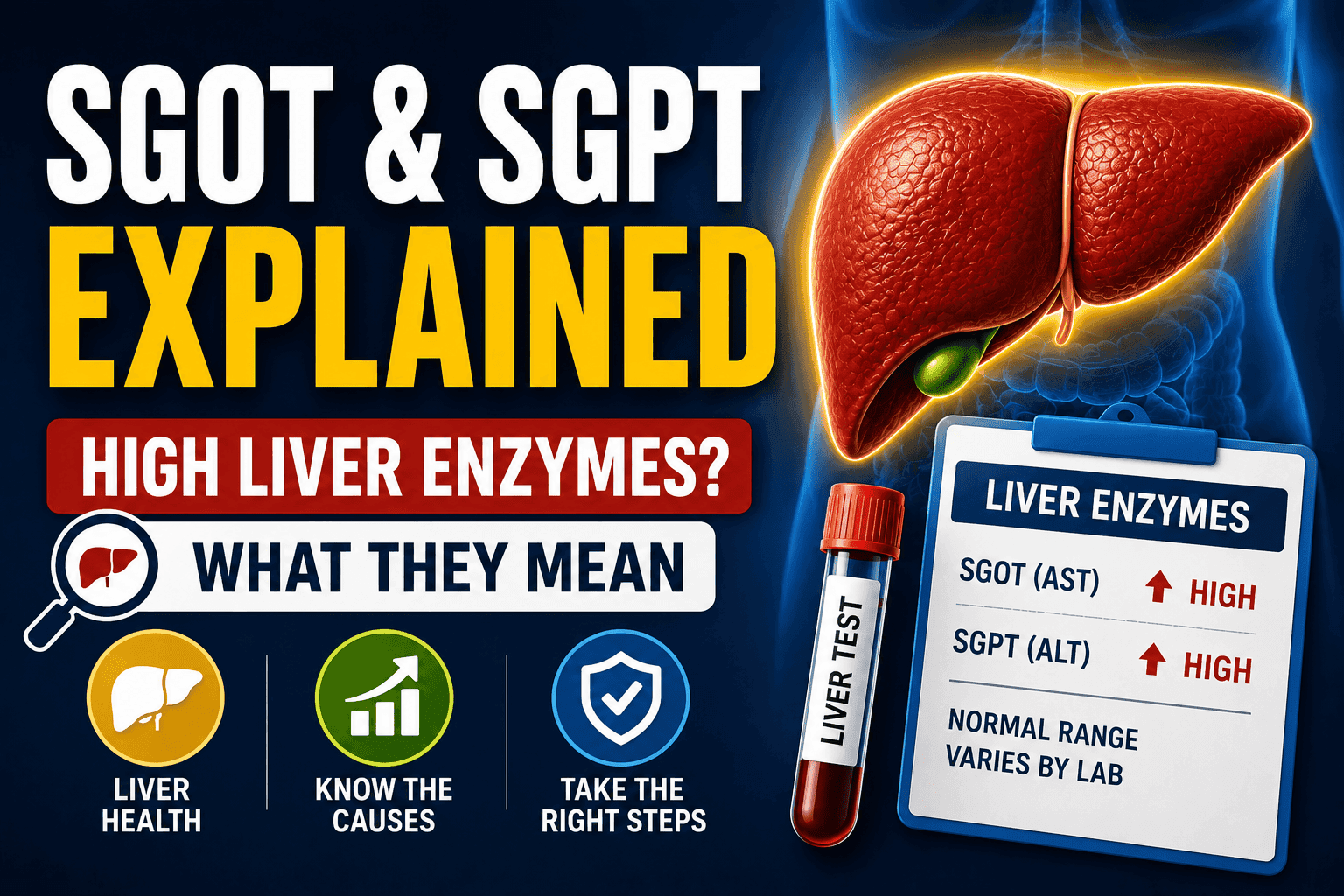
SGOT and SGPT are enzymes, tiny protein workers that live mainly inside your liver cells and help run its chemical reactions. You may also see them written by their newer names: SGPT is the same as ALT (alanine aminotransferase), and SGOT is the same as AST (aspartate aminotransferase). Old name or new, they refer to the same two enzymes, and they are the headline figures in a liver function test.
Here is the key idea. These enzymes are supposed to stay inside the liver cells, doing their job quietly. When liver cells are irritated, inflamed, or damaged, their walls become leaky and the enzymes spill out into the bloodstream. A blood test then picks up higher-than-normal levels.
Think of it like a smoke detector in your kitchen. When it goes off, it is telling you something is wrong, but it does not tell you whether the house is on fire or you merely burnt the toast. Raised enzymes work the same way: they signal that the liver is under some stress, but they do not, by themselves, reveal the cause or the severity. That is why a good doctor treats a high SGOT SGPT test as the start of a conversation, not the end of one.
There is one useful nuance. SGPT (ALT) sits mostly in the liver, so it is fairly liver-specific. SGOT (AST) is found in the liver too, but also in the heart and muscles, so a raised AST can occasionally come from a source other than the liver, such as strenuous exercise or a muscle injury. The pattern between the two often gives doctors their first clue.
What Is a Normal SGOT and SGPT Range?
Ranges vary slightly from one laboratory to another, and your report always prints its own reference values, which are the ones you should read against. As a broad guide, however, a normal liver enzyme test usually falls somewhere around these figures:
- SGPT (ALT): roughly 7 to 55 units per litre.
- SGOT (AST): roughly 8 to 48 units per litre.
Because labs differ, do not be alarmed by tiny variations. A value a whisker above the top of the range is very different from one that is several times higher, and the two are read quite differently.
Doctors also care about the degree of elevation:
- Mildly raised (up to about two to three times normal) is extremely common and often linked to fatty liver or lifestyle factors.
- Moderately raised points more firmly toward active liver inflammation and warrants investigation.
- Markedly raised (many times the normal level) suggests significant liver injury, such as acute hepatitis, and needs prompt medical attention.
A single LFT test is a snapshot, not a verdict. Trends over time, and the full picture alongside other results, matter far more than one flagged number.
Common Causes of High SGPT and SGOT
When someone has high SGPT SGOT on their report, the causes range from utterly benign to genuinely important. Here are the usual suspects, roughly from most to least common in everyday practice.
- Fatty liver disease (MASLD). By far the leading cause of mildly raised enzymes today, linked to weight, blood sugar, and refined-carbohydrate-heavy diets. This is especially common in India.
- Alcohol. Even moderate regular drinking can lift the enzymes. A pattern where AST is notably higher than ALT often points toward alcohol as a factor [Source: Reputable Medical Journal - Guideline].
- Viral hepatitis. Hepatitis B and C, both relevant in India, can raise enzymes, sometimes markedly.
- Medications and supplements. Common painkillers, some antibiotics, certain cholesterol drugs, and, importantly, many unregulated herbal and “liver detox” products can all irritate the liver.
- Recent illness or infection, which can transiently nudge the numbers up.
- Strenuous exercise or muscle injury, which can raise AST in particular, sometimes causing false alarm.
- Autoimmune liver disease. Sometimes the immune system mistakenly attacks the liver, a condition called autoimmune hepatitis, which can push the enzymes up.
- Thyroid disorders and coeliac disease. Problems outside the liver itself, including an underactive or overactive thyroid and coeliac disease, can also show up as raised SGOT and SGPT.
- Rare inherited metabolic disorders. Less commonly, conditions present from birth, such as Wilson’s disease (copper build-up) and haemochromatosis (iron overload), are the cause. These are uncommon but important not to miss, since they need specific treatment.
Notice how many of these are within your influence. That is the encouraging part of the story: most raised enzymes are telling you about something you can change.
What High Liver Enzymes Do Not Mean
It helps to correct two common fears. First, a raised SGOT and SGPT is not the same as liver failure or cirrhosis. In most people with mildly elevated enzymes, the liver is irritated, not permanently damaged, and there is time to act. Second, the exact number does not neatly equal the severity of disease. Someone can have advanced liver scarring with near-normal enzymes, while another person has strikingly high enzymes from a temporary, fully reversible cause. This is precisely why the enzymes are a starting signal, and why proper interpretation by a doctor matters more than a self-diagnosis from a search engine at midnight.
How to Lower Your Liver Enzymes
Because fatty liver and lifestyle are the most common drivers, the steps that lower raised enzymes overlap heavily with general liver health. For most people with a mildly abnormal SGOT SGPT test, these changes make a real difference over a few months.
- Lose modest weight if you are overweight. Losing even 5 to 10% of body weight can meaningfully reduce liver fat and bring enzymes down [Source: Reputable Medical Journal - RCT Study].
- Cut sugar and refined carbohydrates. Sweets, sugary drinks, white rice in large portions, and maida-based foods are the biggest contributors to liver fat.
- Stop or sharply reduce alcohol. This alone can normalise enzymes in people whose drinking is the cause.
- Move more. Regular brisk walking and some strength work reduce liver fat directly.
- Review your medicines and supplements with a doctor. Never stop prescribed medication on your own, but do disclose every tablet, tonic, and herbal product you take, since some are surprising culprits.
- Eat more vegetables, fibre, and protein, and let coffee, which has genuine evidence of being liver-protective, feature without heaps of sugar.
Be wary of anything marketed as a quick “liver detox.” There is no pill or powder that beats the basics, and some of these products can ironically worsen liver enzymes rather than help them.
What Tests Come Next?
If your enzymes are raised, especially more than mildly or on repeat testing, your doctor will look deeper rather than guess. Common next steps include a repeat liver panel after a few weeks to see the trend, an ultrasound of the abdomen to check for fatty liver or other changes, viral hepatitis screening, and blood tests for blood sugar and cholesterol. Where there is concern about scarring, a FibroScan can painlessly measure liver stiffness.
At specialised centres like Bangalore Gastro Centre, this stepwise assessment turns a vague “abnormal report” into a clear answer: what is raising the enzymes, whether any scarring has begun, and exactly what to do about it. That clarity is worth far more than months of quiet worry over two red-flagged numbers.
When Should You See a Specialist?
Book an appointment rather than waiting if any of the following apply: your enzymes are more than mildly raised, they stay high on a repeat test, you have symptoms such as yellowing of the eyes or skin, dark urine, persistent tiredness, nausea, or abdominal pain, or you have known risk factors like hepatitis, heavy alcohol use, or diabetes. Symptoms alongside abnormal enzymes always deserve prompt evaluation, since the combination often points to a cause that needs treatment rather than simple monitoring.
Reading the Pattern: The AST/ALT Ratio and Friends
Experienced doctors do not just look at whether SGOT and SGPT are high; they look at the relationship between them and at the other numbers on the panel. This pattern-reading is what turns a raw liver enzyme test into a meaningful clue.
The ratio between the two enzymes is one such clue. When SGOT (AST) is notably higher than SGPT (ALT), often around twice as high or more, alcohol-related liver injury moves up the list of suspects. When SGPT (ALT) is the higher of the two, fatty liver and viral hepatitis become more likely. It is not a hard rule, but it points the investigation in a sensible direction.
The rest of the liver panel adds further context. Two other values, ALP (alkaline phosphatase) and GGT, tend to rise when the problem lies with bile flow or the bile ducts rather than the liver cells themselves. Bilirubin, the pigment that causes jaundice, shows whether the liver’s waste-clearing function is affected. Albumin and clotting tests reveal how well the liver is performing its manufacturing jobs. Reading all of these together, rather than fixating on a single flagged enzyme, is how a doctor builds an accurate picture from one SGOT SGPT test.
This is also why repeating the test matters. A one-time elevation after a viral illness, a heavy workout, or a weekend of indulgence may simply settle on its own. A doctor will often recheck the enzymes after a few weeks, because a persistent pattern tells a very different story from a passing blip. Acting on a single reading, in either direction, can mislead. The trend is the truth.
None of this is something to work out for yourself from an internet chart. The value of understanding the pattern is not to self-diagnose, but to appreciate why your doctor may order a repeat panel or additional tests rather than reacting to one red-flagged line, and why that measured approach is a sign of good care, not delay.
SGOT & SGPT: Patient Questions Answered
What does high SGOT and SGPT mean?
High SGOT and SGPT mean that liver cells are leaking these enzymes into the blood, usually because the liver is irritated, inflamed, or under some strain. The most common cause is fatty liver, followed by alcohol, viral hepatitis, and certain medicines or supplements. Importantly, raised enzymes are a signal, not a diagnosis: they tell you the liver needs attention but not the exact cause or severity, which is why a doctor investigates further rather than treating the number alone.
How can I lower my liver enzymes?
For most people, the enzymes fall when the underlying cause is addressed. That usually means losing modest weight if overweight, cutting sugar and refined carbohydrates, reducing or stopping alcohol, exercising regularly, and reviewing any medicines or herbal products with a doctor. These steps target fatty liver, the leading cause. Improvement typically shows over weeks to a few months on repeat testing. Avoid unproven “liver detox” products, which can sometimes make enzymes worse rather than better.
What is a normal LFT range?
Ranges vary by laboratory, so always read against the reference values printed on your own report. As a general guide, SGPT (ALT) is often around 7 to 55 units per litre and SGOT (AST) around 8 to 48 units per litre. The degree of elevation matters: a value just above the top of the range is read very differently from one several times higher. A single result is a snapshot, and the trend over time, alongside other tests, is what truly counts.
Are high liver enzymes dangerous?
Usually, mildly raised enzymes are not dangerous in themselves and reflect a treatable cause like fatty liver rather than serious damage. However, they should not be ignored, because occasionally they signal something more important, such as hepatitis or significant liver injury, and because the exact number does not always match the severity. The safe approach is to have raised enzymes properly interpreted, repeat the test as advised, and act on the underlying cause.
Can high SGPT and SGOT come back to normal?
Yes, very often. When the cause is fatty liver, alcohol, or a medication, addressing it frequently returns the enzymes to normal over weeks to months. The liver has a strong capacity to recover once the source of irritation is removed. The key is to find and treat the actual cause rather than chasing the number, and to confirm improvement with a repeat test rather than assuming the problem has resolved.
Why the Test Gets Ordered So Often
You may wonder why an SGOT SGPT test turns up in almost every health-check package. The reason is that the liver is a quiet organ. It can be under considerable strain for a long time while causing no symptoms at all, and by the time obvious signs appear, a problem may be well advanced. Liver enzymes offer an early, inexpensive window into a hidden organ, which is exactly why they earn a place on routine panels.
This is genuinely good news for you. It means that a mildly abnormal result, caught by chance on a screening test, is often an early warning delivered at a stage when the underlying cause, usually fatty liver, is very much reversible. Far from being a reason for dread, an early flag is an opportunity. The people who do best are those who treat that flag as a prompt to change a few habits and recheck, rather than either ignoring it for years or spiralling into panic over a single number.
The Bottom Line
Two red-flagged numbers on a report are unsettling, but SGOT and SGPT are messengers, not verdicts. They tell you your liver is under some stress and asking for attention, most often because of fatty liver, alcohol, a virus, or a medication. In the great majority of cases, the cause is one you can influence, and the enzymes fall once you do.
Do not panic, and do not ignore. If your enzymes are more than mildly raised, stay high on repeat testing, or come with symptoms, get them properly evaluated. The specialists at Bangalore Gastro Centre can pinpoint what is driving the numbers, check whether any scarring has begun, and give you a clear plan to bring your liver, and your report, back to health.
This article is for general education and is not a substitute for personalised medical advice. Please consult a qualified doctor to interpret your specific liver function tests.