


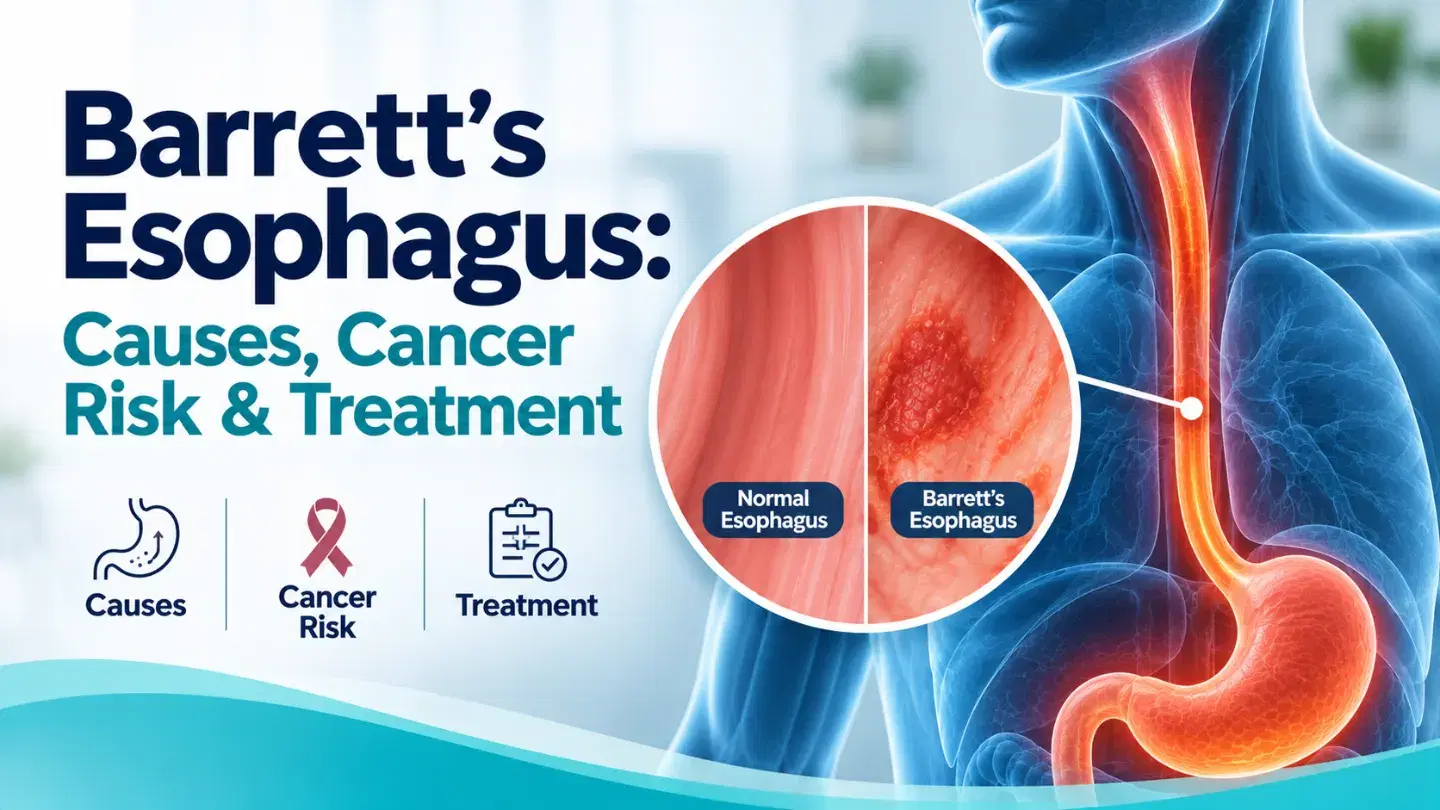
Barrett’s Esophagus: Causes, Cancer Risk & Treatment
Barrett’s Esophagus: Causes, Cancer Risk & Treatment
Being told you have Barrett’s esophagus can be unsettling, especially when the words “cancer risk” enter the conversation. But the reality of this condition is far more reassuring than it first sounds. Barrett’s esophagus is a change in the lining of the food pipe caused by years of acid reflux, and while it does carry a small increased risk of a particular cancer, the large majority of people with it never develop that cancer, especially when it is properly monitored and managed.
This guide explains what Barrett’s esophagus actually is, why long-term reflux causes it, the truth about its cancer risk (neither dismissing it nor exaggerating it), how it is monitored, and the treatment options available today. Understanding it clearly replaces anxiety with a sensible plan.
What Is Barrett’s Esophagus?
To understand Barrett’s esophagus, picture the lining of your food pipe (oesophagus). Normally it is covered by one type of cell, a smooth lining well suited to the passage of food but not built to withstand stomach acid. The stomach, by contrast, has a lining designed to cope with acid.
In Barrett’s esophagus, after years of acid repeatedly washing up from the stomach, the normal lining of the lower oesophagus is gradually replaced by a different, more acid-resistant type of cell, similar to the lining of the intestine. Doctors call this change metaplasia. In effect, the oesophagus re-paves its damaged surface with a tougher material better able to cope with the constant acid “traffic.”
This adaptation is the body’s attempt to protect itself, and in one sense it works, the new lining tolerates acid better. But there is a catch. These replacement cells carry a small risk of undergoing further abnormal changes over time, which is the reason Barrett’s esophagus is monitored. It is, essentially, a change worth keeping an eye on rather than a disease to fear.
What Causes Barrett’s Esophagus?
The single most important cause is long-term gastro-oesophageal reflux disease (GERD), the condition in which stomach acid repeatedly refluxes up into the oesophagus. Years of this acid exposure damage the lining and drive the change to Barrett’s. In essence, Barrett’s is a consequence of chronic, often long-standing, acid reflux.
Several factors increase the likelihood of developing it, including:
- Long-standing or severe GERD and heartburn.
- Being overweight, particularly with fat around the abdomen, which worsens reflux.
- A hiatal hernia, which makes reflux more likely.
- Smoking.
- Being male and older, as Barrett’s becomes more common with age and is more frequent in men.
- A family history of Barrett’s or oesophageal cancer.
Recognising these risk factors matters, because they also point toward who should mention long-standing reflux to their doctor, since Barrett’s is often discovered when chronic reflux is investigated with an endoscopy.
Does Barrett’s Esophagus Cause Symptoms?
Here is something that surprises many people: Barrett’s esophagus itself causes no specific symptoms. The change in the lining does not produce its own sensations. Instead, people with Barrett’s usually have the symptoms of the underlying reflux that caused it: heartburn, acid regurgitation, and sometimes difficulty swallowing.
Confusingly, some people find their heartburn actually lessens once Barrett’s develops, because the new, more acid-resistant lining is less sensitive, which can create a false sense that the reflux problem has resolved. And some people with Barrett’s have had surprisingly few reflux symptoms all along. This is precisely why Barrett’s is often discovered incidentally, during an endoscopy performed for long-standing reflux or other upper digestive symptoms. The absence of specific symptoms is also why people with chronic reflux, especially with risk factors, are sometimes advised to have an endoscopy to check.
The Truth About Barrett’s and Cancer Risk
This is the question that worries people most, so it deserves a clear, balanced answer. Barrett’s esophagus is the main known precursor to a type of cancer called oesophageal adenocarcinoma, and having Barrett’s does increase the risk of this cancer compared with the general population. That is the part that sounds frightening, and it is why the condition is taken seriously.
But here is the essential context that brings reassurance. The actual risk for any individual with Barrett’s is small. The great majority of people with Barrett’s esophagus never develop oesophageal cancer, and each year only a very small percentage progress toward it [Source: Reputable Medical Journal - Cohort Study]. The change usually happens slowly, over years, passing through recognisable stages (called dysplasia) before any cancer develops. This slow, stepwise progression is exactly what makes monitoring so effective: it allows any worrying change to be caught and treated long before it becomes cancer.
So the accurate message is neither “you have a pre-cancer, be terrified” nor “ignore it.” It is this: you have a condition with a small increased risk, which, with sensible monitoring and treatment, can be managed so that the risk is kept low and any change is caught early.
How Barrett’s Is Diagnosed and Monitored
Barrett’s esophagus is diagnosed with an upper GI endoscopy, during which the doctor looks at the lining of the oesophagus and takes small tissue samples (biopsies). The biopsies confirm the characteristic cell change and, importantly, check whether any dysplasia (early abnormal change) is present and, if so, to what degree.
The findings then guide monitoring. For Barrett’s without dysplasia, regular surveillance endoscopies at intervals of a few years are usually recommended, to check that nothing is progressing. If low-grade or high-grade dysplasia is found, monitoring becomes closer and treatment is considered. This surveillance is the heart of managing Barrett’s safely, because it catches any advancing change at a stage when it is highly treatable. At specialised centres like Bangalore Gastro Centre, this careful endoscopic monitoring is tailored to each person’s findings, striking the right balance between vigilance and reassurance.
Treatment Options for Barrett’s Esophagus
Treatment has two aims: controlling the acid reflux that drives the condition, and, where abnormal changes have developed, removing them before they can progress.
Controlling reflux. For most people with Barrett’s and no dysplasia, management centres on controlling reflux, which may slow progression and relieve symptoms. This means acid-reducing medicines, usually proton pump inhibitors, along with the lifestyle measures that reduce reflux: losing excess weight, not eating late at night, raising the head of the bed, avoiding trigger foods, and stopping smoking.
Treating dysplasia or early cancer. When biopsies show dysplasia or very early cancer, modern endoscopic treatments can remove the abnormal lining without major surgery. These include radiofrequency ablation, which uses heat energy to remove the abnormal cells so that healthy lining can regrow, and endoscopic mucosal resection, which removes abnormal areas directly through the endoscope. These techniques are highly effective and have transformed the treatment of advanced Barrett’s, allowing problems to be dealt with before they ever become invasive cancer, and sparing many people from needing major surgery. The right approach depends on the individual findings and is decided with a specialist.
Living With Barrett’s Esophagus
A diagnosis of Barrett’s is a reason for sensible management, not for alarm or a restricted life. The practical priorities are straightforward: keep reflux well controlled with medication and lifestyle measures, attend your surveillance endoscopies as advised, and maintain a healthy weight, since obesity worsens reflux and is a risk factor. Not smoking matters too. Beyond that, most people with Barrett’s live entirely normal lives, reassured by the knowledge that regular monitoring is keeping watch. Understanding that the condition is being actively managed, and that any change would be caught early, does a great deal to ease the natural worry a diagnosis can bring. There is no need to restrict activities, travel, or normal eating beyond the sensible reflux-reducing measures, and no reason to live under a cloud of anxiety; the diagnosis is best treated as a prompt for good habits and regular check-ups rather than a daily preoccupation.
What Influences the Risk of Progression?
Not everyone with Barrett’s esophagus carries the same level of risk, and understanding what influences progression helps put an individual diagnosis in perspective. The single most important factor is whether any dysplasia, early abnormal change in the cells, is present. Barrett’s without dysplasia carries a very low annual risk of progressing toward cancer, while the presence of low-grade or, especially, high-grade dysplasia raises that risk and prompts closer monitoring and often treatment.
Other factors that can influence risk include the length of the Barrett’s segment (longer segments carry somewhat higher risk), ongoing uncontrolled reflux, obesity, smoking, and being older and male. The reassuring flip side is that several of these are within your influence: controlling reflux well, maintaining a healthy weight, and not smoking all support the goal of keeping risk low. This is why management is not passive watching but active care, controlling the reflux that drives the condition while surveillance keeps watch. For the great majority, this combination keeps Barrett’s a stable, monitored condition rather than one that progresses.
Common Myths About Barrett’s Esophagus
Several misunderstandings cause unnecessary fear, so they are worth correcting. The first myth is that Barrett’s esophagus means you have, or will inevitably get, cancer. In reality, it is a risk factor, not cancer, and most people with it never develop cancer. The second myth is that because heartburn has improved, the reflux problem, and therefore Barrett’s, has gone away. In fact, the more acid-resistant Barrett’s lining can make heartburn feel better even as reflux continues, which is why ongoing management and monitoring remain important regardless of symptoms.
A third myth is that nothing can be done. On the contrary, reflux can be controlled, risk factors can be reduced, and, where abnormal changes develop, highly effective endoscopic treatments can remove them before they progress. A fourth is that surveillance endoscopies are pointless; in truth, they are the very thing that keeps Barrett’s safe, catching any change early. Replacing these myths with accurate understanding transforms Barrett’s from a source of dread into a manageable condition that is simply being kept under sensible watch.
Barrett’s Esophagus: Patient Questions Answered
What is Barrett’s esophagus?
Barrett’s esophagus is a change in the lining of the lower food pipe (oesophagus) caused by long-term acid reflux. After years of acid washing up from the stomach, the normal lining is gradually replaced by a different, more acid-resistant type of cell, similar to the intestinal lining, a change doctors call metaplasia. It is essentially the oesophagus adapting to constant acid exposure. The change itself causes no specific symptoms, but it carries a small increased risk of a type of oesophageal cancer, which is why it is monitored.
Can Barrett’s esophagus turn into cancer?
It can, but for any individual the risk is small, and the great majority of people with Barrett’s never develop cancer. Barrett’s is the main known precursor to oesophageal adenocarcinoma, so it does raise the risk compared with the general population. However, progression is usually slow, passing through recognisable stages (dysplasia) over years before any cancer develops. This slow, stepwise change is exactly why regular monitoring is so effective, as it allows any worrying change to be caught and treated well before it becomes cancer. With surveillance and treatment, the risk is kept low.
How is Barrett’s esophagus treated?
Treatment has two parts. For most people with Barrett’s and no abnormal (dysplastic) changes, management focuses on controlling the underlying acid reflux with acid-reducing medicines such as proton pump inhibitors, plus lifestyle measures like weight loss, not eating late, raising the head of the bed, and stopping smoking, alongside regular surveillance endoscopies. If dysplasia or very early cancer is found, modern endoscopic treatments, such as radiofrequency ablation or endoscopic mucosal resection, can remove the abnormal lining without major surgery, highly effectively, before it can progress.
Is Barrett’s esophagus cancer?
No, Barrett’s esophagus is not cancer. It is a change in the lining of the oesophagus that carries a small increased risk of developing into a type of cancer over time. The distinction matters: Barrett’s is a risk factor and a precursor condition, not a malignancy. Most people with it never develop cancer. Thinking of it as a condition to monitor and manage, rather than as cancer itself, is both accurate and reassuring. Regular surveillance exists precisely to ensure that, in the small number who do progress, changes are caught and treated early.
Who should be checked for Barrett’s esophagus?
People with long-standing or frequent acid reflux and heartburn, particularly when combined with risk factors, are the ones who may be advised to have an endoscopy to check for Barrett’s. Those risk factors include being overweight (especially with abdominal fat), having a hiatal hernia, smoking, being older and male, and having a family history of Barrett’s or oesophageal cancer. Because Barrett’s itself causes no specific symptoms and is detected by endoscopy, discussing long-standing reflux with your doctor is the route to being assessed, rather than waiting for a symptom that the condition does not produce.
The Bottom Line
Barrett’s esophagus sounds alarming, but understood properly it is a manageable condition rather than a frightening one. It is the oesophagus adapting to years of acid reflux by re-paving its lining with tougher cells, a change that carries a small increased risk of a particular cancer. The key word is small: most people with Barrett’s never develop cancer, and because the change progresses slowly through recognisable stages, regular monitoring catches any problem early, when it is highly treatable.
The sensible path is clear: control the reflux that caused it, keep a healthy weight, avoid smoking, and attend your surveillance endoscopies. If you have long-standing reflux, especially with risk factors, it is worth discussing with your doctor whether you should be checked. The specialists at Bangalore Gastro Centre can diagnose, monitor, and treat Barrett’s esophagus expertly, keeping the risk low and giving you the reassurance of knowing it is being watched.
The best way to hold it all in mind is this: Barrett’s is a consequence of long-term reflux, a signal that acid has been troubling the oesophagus for years. Treating that reflux seriously is good for your comfort and good for your oesophagus, and the regular monitoring that comes with the diagnosis is not a cause for anxiety but a safeguard working quietly in your favour. Managed this way, Barrett’s becomes simply one more thing kept sensibly under review, rather than a shadow hanging over daily life.
This article is for general education and is not a substitute for personalised medical advice. Please consult a qualified gastroenterologist about reflux symptoms and Barrett’s esophagus.