


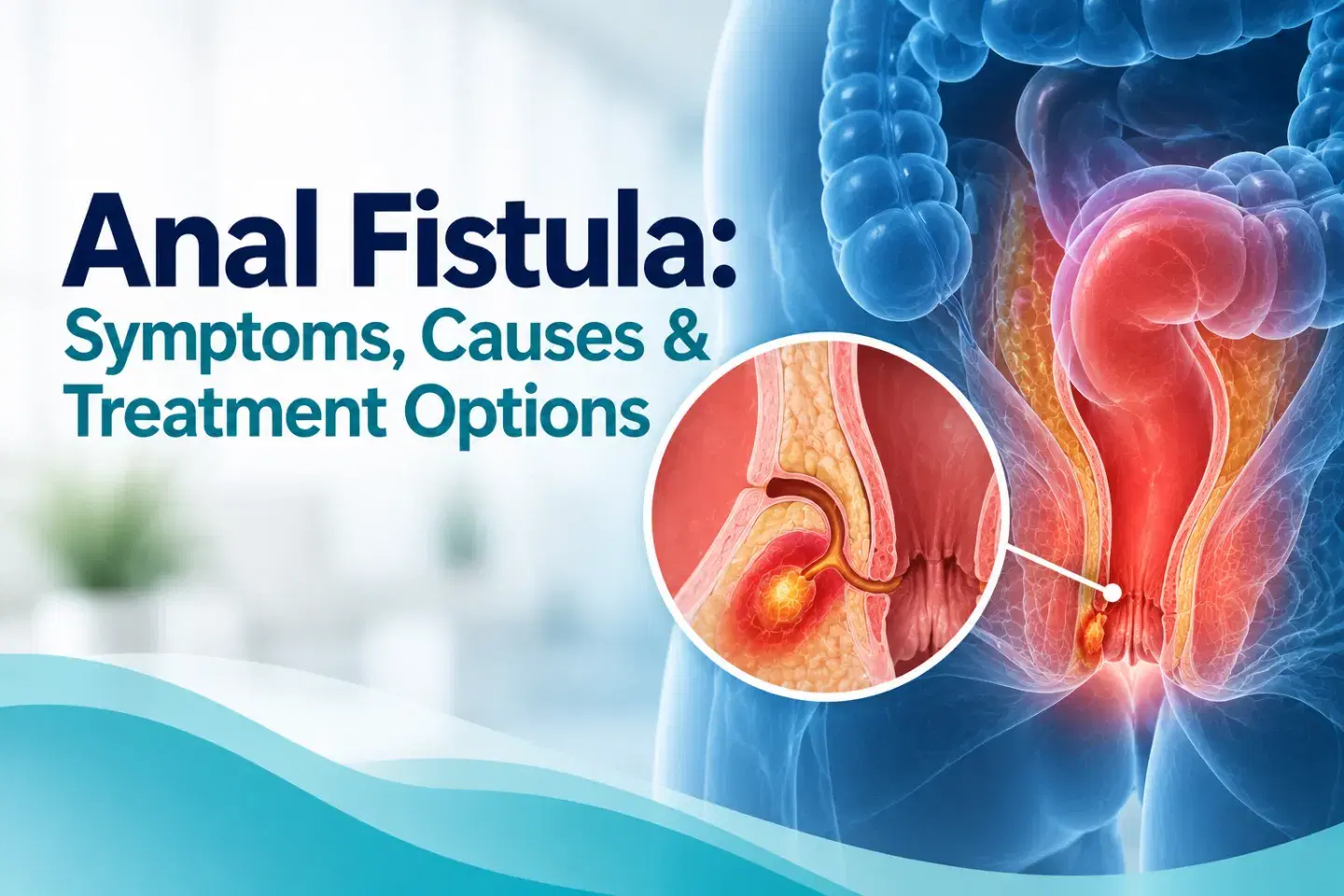
Anal Fistula: Symptoms, Causes & Treatment Options
Few conditions are as uncomfortable to talk about, or as frustrating to live with, as an anal fistula. It announces itself with a recurring cycle of painful swelling near the anus, followed by a discharge of pus and a temporary relief, only for the whole thing to build up again weeks later. Many people endure this cycle for months, embarrassed to seek help, hoping it will simply heal.
Here is the honest truth that changes everything: an anal fistula almost never heals on its own, and the recurring infection will keep returning until the underlying tunnel is properly treated. The equally good news is that modern medicine offers several effective treatments, including sphincter-sparing options that cure the fistula while protecting normal control. This guide explains what an anal fistula is, its symptoms and causes, and the modern treatment options that can finally end the cycle.
What Is an Anal Fistula?
An anal fistula, known medically as fistula-in-ano, is a small abnormal tunnel that forms between the inside of the anal canal and the skin on the outside, near the anus. Picture a tiny underground pipe running from within the back passage to an opening on the skin surface.
To understand where it comes from, you need to know about the anal glands. Inside the anal canal sit small glands that can occasionally become blocked and infected. When one does, the infection builds into a collection of pus called a perianal abscess. That abscess needs to drain, and when it does, whether it bursts on its own or is drained by a doctor, it can leave behind a permanent tunnel connecting the original infected gland to the skin. That tunnel is the fistula.
This origin story explains the condition’s most characteristic feature: its stubborn, recurring nature. As long as the tunnel exists, it can repeatedly fill with infection, swell, become painful, and discharge, only to repeat the cycle. It is like a leaking underground drain left behind after a burst pipe. Patching the surface never works, because the whole tunnel is the problem. This is precisely why an anal fistula so rarely resolves without proper treatment.
Anal Fistula Symptoms
The symptoms of a fistula-in-ano follow a recognisable, often cyclical, pattern. Common anal fistula symptoms include:
- Recurrent swelling, pain, or a throbbing lump near the anus, which builds up as infection collects.
- Discharge of pus, blood, or sometimes fluid with an unpleasant smell from an opening in the skin near the anus. This discharge often brings temporary relief as the pressure releases.
- A cyclical pattern: the area swells and hurts, then drains and eases, then builds up again, over and over.
- Skin irritation and itching around the anus from the constant moisture and discharge.
- Pain that worsens when sitting, moving, or passing stool.
- Fever and feeling unwell when an active abscess is present.
This build-up-and-drain cycle is the hallmark that distinguishes a fistula from other anal conditions. If you have a recurring abscess or a persistent leaking opening near the anus, a fistula is the likely explanation, and it needs proper assessment.
What Causes an Anal Fistula?
The large majority of anal fistulas arise from the blocked, infected anal gland and perianal abscess described above, a process doctors call cryptoglandular infection. It is the everyday cause behind most cases.
However, some fistulas are linked to underlying conditions, and identifying these matters, because they change the treatment. Important causes to be aware of include:
- Crohn’s disease. This inflammatory bowel condition can cause fistulas, sometimes complex ones, and requires both medical treatment of the underlying disease and specialised surgical care.
- Tuberculosis, which remains a relevant cause in India and needs specific treatment.
- Previous surgery, trauma, or radiation to the area.
- Certain infections and, rarely, other conditions.
Because the cause shapes the treatment, a proper evaluation looks not just at the fistula itself but at whether anything underlying is driving it. A fistula that keeps recurring despite treatment, or one that is complex or multiple, always raises the question of an underlying condition like Crohn’s disease.
Can an Anal Fistula Heal Without Surgery?
This is the question patients most hope to answer with a “yes,” so honesty is important. In the vast majority of cases, an anal fistula does not heal on its own and cannot be cured without a procedure. The tunnel remains, and as long as it does, the infection returns.
The reason is structural. Creams, antibiotics, and home remedies may calm an active infection temporarily, but they cannot close the tunnel itself. Antibiotics alone treat the flare, not the fistula. This is why people who try to manage a fistula with medication alone find themselves stuck in the same recurring cycle for months or years. Definitive cure almost always requires a procedure to deal with the tunnel. The encouraging part is that these procedures are well established, effective, and, in experienced hands, designed to protect normal bowel control.
Modern Treatment Options for Anal Fistula
The goal of fistula surgery is twofold: eradicate the tunnel so the infection stops recurring, and preserve the anal sphincter muscles that control continence. Because the fistula often runs through or near these muscles, protecting them is a central concern, and modern techniques increasingly focus on doing exactly that. The right option depends on how simple or complex the fistula is, how much muscle it involves, and its cause.
- Fistulotomy. For simple, low fistulas that involve little muscle, the surgeon lays the tunnel open so it can heal from the inside out. This has a high success rate and is a common, effective option when the fistula is straightforward.
- Seton placement. For higher or more complex fistulas that involve more of the sphincter, a thread called a seton is passed through the tunnel. It keeps the tract draining and, depending on the type, gradually helps it heal while protecting the muscle. In India, a traditional medicated-thread technique known as kshar sutra works on a similar seton principle and is practised in some centres; as with all options, it is best undertaken by experienced hands and chosen for the right type of fistula.
- Sphincter-sparing procedures. Techniques such as the LIFT procedure (which ties off the tract between the muscle layers) and advancement flaps (which use nearby tissue to close the internal opening) are designed to cure the fistula while preserving continence.
- Newer minimally invasive options. Approaches including laser closure of the tract, a fistula plug, tissue glue, and video-assisted techniques aim to treat the fistula with minimal disturbance to the muscle. Their suitability and success vary with the individual fistula.
Choosing among these is a specialist decision. Complex, high, recurrent, or Crohn’s-related fistulas in particular need an experienced colorectal specialist, often with detailed imaging such as an MRI to map the tunnel before treatment. At specialised centres like Bangalore Gastro Centre, the fistula is assessed carefully and the treatment matched to its anatomy and cause, with preserving continence a central priority.
Why You Shouldn’t Delay Treatment
It is tempting to put off dealing with such a private problem, especially when the discharge brings periodic relief. But delay carries real costs. Each cycle of infection can cause the fistula to branch and become more complex, turning a simple, easily treated tunnel into a complicated one that is harder to cure and more likely to threaten continence. Long-standing, repeatedly infected fistulas are also, very rarely, associated with other changes over time. Treating a fistula while it is simple gives the best chance of a straightforward cure with the least risk. Embarrassment is understandable, but it is the single biggest reason people end up with harder-to-treat disease.
How an Anal Fistula Is Diagnosed
Diagnosing a fistula is partly straightforward and partly detailed detective work, because the visible opening on the skin is only one end of a tunnel whose full path must be mapped before it can be treated safely. It begins with a careful history of the recurring symptoms and an examination of the area, during which the doctor can often see the external opening and feel the tract beneath the skin.
For simple, low fistulas, this examination may be enough to plan treatment. For anything more complex, however, accurately mapping the tunnel is essential, especially its relationship to the sphincter muscles that control continence, since this determines which procedure is safe. Here, an MRI scan of the pelvis is the most useful tool, producing a detailed picture of the tract, any branches, and how much muscle it involves. In some cases, an examination under anaesthesia allows the surgeon to probe the tract gently and define it fully before deciding on treatment. Where an underlying condition such as Crohn’s disease is suspected, further tests, including a colonoscopy, may be arranged. This careful mapping is what allows a specialist to choose a treatment that cures the fistula while protecting normal control, rather than risking the muscle by operating blind.
Anal Fistula vs Other Anal Conditions
Because several anal conditions cause overlapping discomfort, it helps to understand how a fistula differs from its neighbours, since the treatments are very different. A fistula is defined by its recurring cycle of swelling and discharge from an opening near the anus, reflecting the underlying tunnel.
An anal fissure, by contrast, is a small tear in the lining of the anal canal that causes sharp pain during bowel movements and bright red bleeding, without the persistent discharge of a fistula. Haemorrhoids (piles) are swollen blood vessels that typically cause painless bleeding, itching, or a lump, again without the abscess-and-discharge pattern. A perianal abscess is the acute, painful collection of pus that often precedes a fistula; it is the “burst pipe” that can leave the tunnel behind. Distinguishing these matters because their treatments diverge sharply, from creams and stool softeners for a simple fissure to surgery for a fistula. This overlap is exactly why a proper examination is worthwhile rather than assuming which condition is present, and why recurring symptoms near the anus should be assessed rather than self-treated.
Anal Fistula: Patient Questions Answered
What is an anal fistula?
An anal fistula, or fistula-in-ano, is a small abnormal tunnel that connects the inside of the anal canal to the skin near the anus. It usually forms after a perianal abscess, an infection of a small anal gland, drains and leaves a permanent tract behind. Because the tunnel remains, it can repeatedly fill with infection, swell, become painful, and discharge pus, then temporarily settle, in a frustrating recurring cycle. This build-up-and-drain pattern near the anus is the hallmark of a fistula and is what distinguishes it from other anal conditions.
Can an anal fistula heal without surgery?
In the vast majority of cases, no. An anal fistula rarely heals on its own, because the underlying tunnel remains and keeps getting infected. Creams and antibiotics may calm an active flare temporarily but cannot close the tract itself, which is why managing a fistula with medication alone leads to the same recurring cycle. Definitive cure almost always requires a procedure to deal with the tunnel. The reassuring part is that these procedures are effective and, in experienced hands, are increasingly designed to protect normal bowel control.
What is the best treatment for an anal fistula?
There is no single best treatment for everyone; the right one depends on how simple or complex the fistula is and how much muscle it involves. Simple, low fistulas are often cured with a fistulotomy, which lays the tract open. Higher or more complex fistulas may need a seton, sphincter-sparing procedures such as the LIFT technique or an advancement flap, or newer minimally invasive options like laser closure. Protecting continence is a central priority. A specialist assessment, sometimes with an MRI, determines the safest, most effective option for your specific fistula.
Is anal fistula surgery painful, and what is recovery like?
Fistula procedures are done under anaesthesia, so the operation itself is not felt, and modern approaches aim to minimise discomfort. Afterwards, there is usually some pain, discharge, and the need for careful hygiene while the area heals, which can take a few weeks depending on the technique and the fistula’s complexity. Sitz baths (sitting in warm water), good wound care, and keeping stools soft all ease recovery. Most people return to normal activities before full healing is complete. Your surgeon will give specific aftercare guidance for your procedure.
Can an anal fistula come back after treatment?
Yes, fistulas can recur, particularly complex ones or those linked to an underlying condition such as Crohn’s disease. Recurrence is more likely when a fistula was complex, was not fully treated, or when an underlying cause was not addressed. This is exactly why proper assessment matters: mapping the tunnel accurately, choosing the right procedure, and identifying any underlying disease all reduce the chance of return. Treating a fistula while it is still simple, rather than after repeated infections have made it complex, also improves the odds of a lasting cure.
The Bottom Line
An anal fistula is a stubborn but very treatable condition. It is a small tunnel left behind after an abscess, and because that tunnel stays open, it drives the frustrating cycle of recurring swelling, pain, and discharge that so many people endure in silence. The essential thing to understand is that it will not heal on its own, and no cream or antibiotic course will close it; definitive cure needs a procedure.
The modern picture is genuinely encouraging: a range of effective treatments exists, many of them designed to cure the fistula while carefully preserving normal control. The key is to seek help early, before repeated infections make a simple fistula complex. If you have a recurring abscess or persistent discharge near the anus, the specialists at Bangalore Gastro Centre can assess the fistula properly and choose the treatment that offers a lasting cure with the least risk.
There is no reason to endure this condition in silence. However private and uncomfortable it feels, an anal fistula is a common, well-understood problem that doctors treat routinely, and modern, muscle-sparing techniques mean a cure rarely comes at the cost of normal control. The sooner it is assessed, the simpler and more successful that cure tends to be.
This article is for general education and is not a substitute for personalised medical advice. Please consult a qualified colorectal or gastrointestinal specialist about an anal fistula.